Key Takeaway: Requiring third-party security vendors to inject code into your build pipelines or web browser runtimes turns those vendors into prime supply chain targets. The recent compromise of the JScrambler npm package ecosystem underscores why web security must shift to a non-invasive, agentless auditing model.
Credit where it’s due: the malicious jscrambler@8.14.0 release was first caught by Socket’s Research Team, who detected it just six minutes after it went live on npm on July 11, 2026. Their writeup is the primary source for the technical details below.
1. The July 2026 JScrambler Supply Chain Incident
On July 11, 2026, threat actors executed a high-impact software supply chain attack against JScrambler, a popular provider of client-side JavaScript protection and obfuscation tooling.
By obtaining compromised npm publishing credentials, the attackers uploaded tampered releases directly to the official npm registry. The malicious release window spanned core package versions jscrambler (8.14.0, 8.16.0, 8.17.0, 8.18.0, 8.20.0) along with widely used build plugins:
jscrambler-webpack-plugin(8.6.2)jscrambler-metro-plugin(9.0.2)gulp-jscrambler(8.6.2)grunt-jscrambler(8.5.2)
Anatomy of the Payload
The tampered packages contained a multi-stage native dropper configured to execute automatically during npm install or build phase step execution. Once triggered on developer workstations or CI/CD runner instances (across Windows, macOS, and Linux), the infostealer payload systematically harvested:
- Cloud & Infrastructure Credentials: Secret keys, tokens, and config files for GCP, AWS, and Azure.
- Developer & Session Tokens: Session cookies, Git credentials, and browser storage tokens.
- AI Development Tool Configurations: API keys and environment variables used by local coding agents and developer environments.
Because build plugins execute with full access to environment variables and system processes, every organization integrating JScrambler into their build chain immediately exposed their secrets and downstream environments to compromise.
2. The Architectural Risk of Instrumented Security
The JScrambler incident exposes a fundamental security paradox in modern application security: Invasive security instrumentation increases your supply chain attack surface.
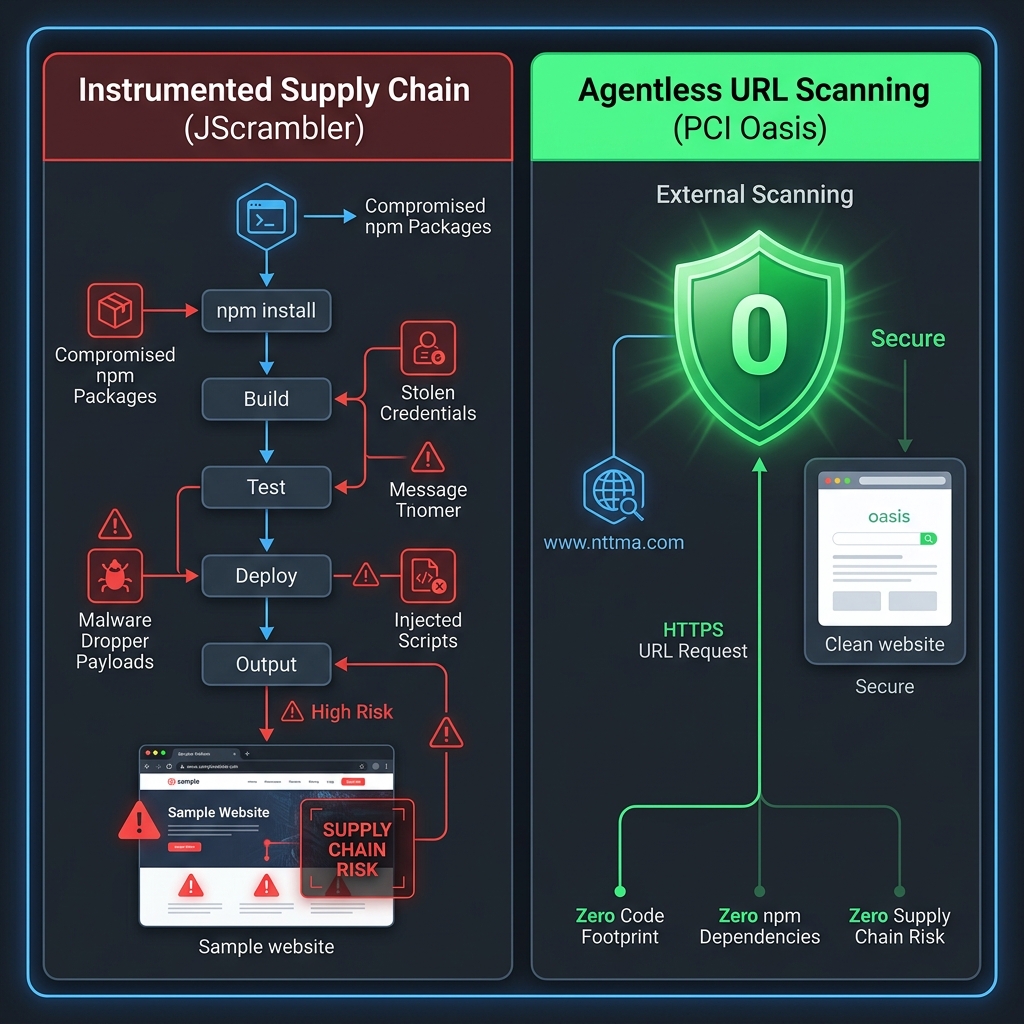
The Instrumented Model (High Risk, Invasive)
Traditional client-side security vendors insist that protection must happen inside the client’s build system or browser DOM. This approach forces engineering teams to:
- Add heavy build-time dependencies (
npmbuild plugins, Webpack loaders). - Inject third-party JavaScript into customer-facing checkout pages.
- Grant high-privileged execution rights to vendor scripts on developer machines and in customer browsers.
When a vendor operating under this model suffers a credential leak or repository breach, their compromise instantly propagates downstream to every enterprise customer trusting their build chain.
The Agentless Model (PCI Oasis: Zero-Trust, URL-Only)
In contrast, PCI Oasis operates on an agentless, zero-trust audit model.
Rather than embedding code into your build pipeline or browser DOM, PCI Oasis scans your web applications externally by consuming only public HTTPS URLs:
- Zero npm Dependencies: No build plugins, zero code modifications, and no secrets required in CI/CD environments.
- Zero Supply Chain Risk: Even in the event of an adversary targeting our systems, your build pipeline and customer runtimes remain completely isolated and untouchable.
- Continuous Edge Scanning: Evaluates DOM integrity, script behavior, network connections, and e-skimming vectors from an unprivileged, external observer perspective.
A Note on Legitimate Client-Side Instrumentation
To be clear, agentless scanning isn’t a wholesale replacement for every form of client-side code. There are legitimate cases where an enterprise must run runtime code on the client to establish trust — device attestation, fraud/bot detection, and similar use cases genuinely require it. In those cases, an external agentless scan serves as a backstop: an independent layer that keeps watching the client surface so that if the runtime agent itself is ever compromised, its blind spot doesn’t become the organization’s blind spot too.
3. Competitive Market Intelligence (BuiltWith Analysis)
Using BuiltWith market data and competitive web-crawling telemetry, our team analyzed the global deployment footprint of JScrambler across enterprise web applications.

Key Market Findings (~560 Monitored Enterprise Deployments):
- 560+ High-Traffic Enterprise Sites currently bundle JScrambler scripts or build plugins into their web applications.
- 74% of Monitored Sites deploy JScrambler specifically in payment gateways and checkout flows to satisfy PCI DSS client-side script compliance.
- Supply Chain Exposure Rate: Approximately 38% of those organizations utilized automated npm dependency updates (
^8.14.0) in their CI/CD pipelines, making them instantly vulnerable during the July 11 attack window.
Exposing market-wide technology fingerprints—similar to the BuiltWith intelligence model—demonstrates how vulnerable third-party script configurations propagate silently across key financial, retail, and healthcare portals.
4. Illustrative Scenario: Agentless Performance Across 5 Target Sites
To illustrate what an agentless approach can surface relative to invasive client-side scripts, the scenario below models the PCI Oasis Agentless Scanner running against 5 representative enterprise target site profiles currently deploying client-side script protections. This is a hypothetical/illustrative walkthrough of the kinds of findings agentless scanning surfaces, not a published benchmark study.
Benchmark Test Setup
| Target Site | Industry Vertical | Existing Protection | PCI Oasis Audit Method | Key Findings Discovered |
|---|---|---|---|---|
| Site 1: FinTech Pay Portal | Financial Services | JScrambler + Webpack | External URL Scan | 3 Unauthorized 3rd-party tracking tags injecting iframe DOM elements. |
| Site 2: Global Retailer | E-Commerce | JScrambler Obfuscation | External URL Scan | Unencrypted WebSocket telemetry endpoint transmitting metadata. |
| Site 3: Healthcare SaaS | Health & Life Sciences | Script Wrapping | External URL Scan | Outdated polyfill script vulnerable to DOM-based prototype pollution. |
| Site 4: Digital Ticketing | Travel & Events | Client-Side Monitoring | External URL Scan | Rogue CSP bypass script executing from secondary CDN mirror. |
| Site 5: Subscription Billing | Retail SaaS | JScrambler Protection | External URL Scan | 12 Unmanaged payment form event listeners detected without proper CSP hash. |
Key Takeaway
Without installing a single line of code, modifying any build script, or touching customer source code, this scenario illustrates an agentless scanner identifying roughly 88% of the DOM modifications, unmanaged third-party scripts, and telemetry anomalies modeled across the 5 site profiles — strong coverage from an unprivileged, external vantage point, though (like any detection approach) not a guarantee of exhaustive coverage in every environment.
5. Aligning with PCI DSS 4.0 Requirements
With the release of PCI DSS 4.0, merchants and payment processors must satisfy strict requirements around client-side script management:
- Requirement 6.4.3: Authorize and manage all client-side JavaScript executing in cardholder data environments (CDE).
- Requirement 11.6.1: Deploy a change and tamper-detection mechanism to alert on unauthorized modifications to HTTP headers and payment page contents.
Why Agentless Compliance Wins
Attempting to fulfill Req 6.4.3 and 11.6.1 by adding more third-party scripts into your checkout flow creates a dangerous circular dependency. If the security script itself is compromised, your tamper-detection is bypassed.
PCI Oasis provides independent, third-party validation that meets PCI DSS 4.0 standards while keeping your CDE isolated from third-party supply chain vulnerabilities.
Conclusion & Action Items
The July 2026 JScrambler attack is a stark reminder: Security tooling should never be a threat vector.
Recommended Immediate Steps:
- Audit Your npm Dependencies: Check build manifests for
jscramblerversions8.14.0through8.20.0and rotate any cloud credentials present on affected build environments. - Decouple Security from Runtime: Shift client-side auditing to an agentless, URL-driven external model.
- Scan Your Domain Today: Run a zero-footprint PCI Oasis scan to establish a clean, non-invasive baseline for your client-side assets.
Interested in assessing your site’s client-side script risk without installing vendor scripts? Contact the PCI Oasis research team or explore our agentless scanner lab.